
The Enneagram: Structure and Dynamics
The Enneagram is a psychological–spiritual typology describing nine interrelated personality patterns organized around core motivations, habitual ways of perceiving reality, and characteristic defenses. Each type reflects a distinct constellation of core motivations or basic desires (what the person most longs for) and basic fears (what the person most seeks to avoid). These motivations shape attention, emotional patterns, and habitual behaviors, making the Enneagram less a taxonomy of external traits than a model of underlying drives.
The Nine Types
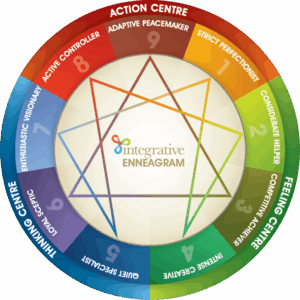
While terminology varies slightly among practitioners, the nine points of the Enneagram typically correspond to:
- Type One: The Reformer/Perfectionist strives for integrity and correctness; fears corruption or being wrong.
- Type Two: The Helper/Giver seeks to be needed and loved; fears being unwanted.
- Type Three: The Achiever/Performer pursues success and admiration; fears failure or worthlessness.
- Type Four: The Individualist/Romantic desires identity and authenticity; fears being insignificant or without identity.
- Type Five: The Investigator/Observer seeks knowledge and self-sufficiency; fears incompetence or depletion.
- Type Six: The Loyalist/Skeptic longs for security and support; fears chaos or abandonment.
- Type Seven: The Enthusiast/Epicure pursues freedom and enjoyment; fears pain or deprivation.
- Type Eight: The Challenger/Protector desires autonomy and strength; fears vulnerability or being controlled.
- Type Nine: The Peacemaker/Mediator strives for harmony and inner peace; fears conflict and disconnection.
Wings
An individual’s dominant type is commonly influenced by the adjacent types on either side of it on the Enneagram symbol. These are called “wings.” For example, a dominant Type Three may show qualities of either Type Two (“Three-with-a-Two-wing”) or Type Four (“Three-with-a-Four-wing”), producing nuanced expressions of the core type.
Subtypes (Instinctual Variants)
Beyond wings, each type is further shaped by one of three instinctual drives:
- Self-Preservation (SP): oriented toward safety, material security, and comfort.
- Social (SO): oriented toward belonging, status, and group connection.
- One-to-One or Sexual (SX): oriented toward intensity, attraction, and pair-bonding.
Combining the nine types with these instinctual variants yields 27 sub-type patterns, offering fine-grained distinctions in motivation and behavior.
The Three Centers
The Enneagram also groups the nine types into three Centers of Intelligence or Triads, reflecting primary ways of processing experience:
- Body/Gut Center (Types 8-9-1): driven by instincts and issues of control, anger, and autonomy.
- Heart/Feeling Center (Types 2-3-4): oriented around image, relationship, and emotional identity.
- Head/Thinking Center (Types 5-6-7): concerned with security, planning, and mental frameworks.
Each center highlights a dominant emotion—anger, shame, or fear—that underlies the motivations of its types, and each offers a pathway for growth through balancing the under- and over-use of that center’s intelligence.
Enneagram Circle (Integrative Enneagram 9)[1]
Discovering Your Type
There are two main traditions for type discovery:
Narrative – This method, refined by Helen Palmer, helps people discover their type as they narrate their inner selves in safe spaces of readings, intentional interviews, panels, and group discussions. This method takes some time and is preferred by those who enjoy experiencing the journey of self-awareness with others. See Helen Palmer’s website for more details.
Instrumented – This method uses psychometric inventories that have been tested to accurately reveal one’s type. It is especially helpful in teasing out some of the finer distinctions between types that one may not discern on their own. See the versions by Jerome Wagner, Don Riso & Russ Hudson, and Integrative Enneagram 9. IEQ9 is regarded as the world’s most accurate and comprehensive Enneagram assessment. It is the result of a collaboration with the most recognized Enneagram specialists worldwide.
Both traditions are valid, and some suggest combining the two.
Background
Enneagram is widely used today, but it is not a new model. In incipient forms, it has a long history of dating back to the Greek philosopher, Pythagoras (570-490 BCE), and incorporating elements from ancient Sufis, Christians, Buddhists, Taoists, and Jews. Versions of the symbol of interlocking triangles appear throughout this history.
Armenian philosopher George Ivanovich Gurdjieff reintroduced the ancient Enneagram symbol at the turn of the 20th century. He used it to describe cosmic patterns and processes evident in nature, music, and everyday human rhythms. His teaching, known as The Fourth Way, emphasized integrating the three centers of intelligence — head, heart, and body.
Gurdjieff began teaching in Moscow in the early 1900s, moved to Istanbul in 1917, and eventually settled in France, directing a teaching center at Fontainebleau outside Paris. He continued teaching in Paris during World War II and until his death in 1949. His approach encouraged students to gain inner freedom by observing the “auto-pilot” tendencies of the mind. Gurdjieff’s followers still explore what he called Objective Science, rooted in the “Law of Three” and “Law of Seven” represented in the Enneagram diagram. The ultimate goal of his system is to transcend the “asleep personality” and what he termed the “chief feature” of the self.
In the mid-20th century, Bolivian philosopher Oscar Ichazo “received” the theory of Protoanalysis, a complex system of cosmology, metaphysics and trans-personal psychology. The personality Enneagram was only a part of this system and was largely a synthesis of Gurdjeieff’s teaching. Through the influence of his Arica School, Ichazo is often regarded as the father of Enneagram, but one of his students, Claudio Naranjo (1932-2019), M.D., a Chilean medical psychiatrist, refined and popularized it.
Naranjo was led to Ichazo in 1970 during a period of spiritual searching after the accidental death of his son. By that time in his educational journey, he had direct exposure to Fritz Perls’ Gestalt Therapy, Gordon Allport’s Social Psychology, and Raymond Cattell’s personality and ability testing. He had also been a student of the spiritual theology of Paul Tillich. Naranjo was dismissed from the Arica school but took recordings of Ichazo’s lectures and integrated his extensive background in psychology and spirituality into the Enneagram. In 1971, he began teaching the material to a confidential group, the Seekers After Truth Institute (SAT), in Berkely, California. The confidentiality was compromised as students spread his teachings. Over the next twenty-plus years, the SAT became internationally renowned in the US, Europe, Brazil, Argentina, and Mexico. In the process, Naranjo refined what is now the modern Enneagram typology, including the 27 instinctual subtypes archetype, and most especially the use of Western psychological terms to describe these constructs.
Some of Naranjo’s most influential students included Helen Palmer and Robert Ochs. Palmer (https://helenpalmer.com/) and her associate, David Daniels, developed the Narrative Tradition (https://www.narrativeenneagram.org/), which uses interview panels and structured interactions in type discovery. She taught Ginger Lapid-Bogda who went on to specialize in Enneagram applications to business and corporate settings (https://theenneagraminbusiness.com/). Lapid-Bogda and Palmer both influenced Beatrice Chestnutt, who focuses on personal transformation and leadership team development (https://www.beatricechestnut.com/leadership). Some renowned practitioners trained under several traditions that emerged from Naranjo and his students. For example, Katherine Fauvre (https://www.katherinefauvre.com/) studied under both Ichazo and Naranjo, and certified under both Palmer-Daniels and Riso-Hudson. Fauvre pioneered the Enneagram tri-type, which assesses the dynamic of one’s strongest tendencies in each of the three centers of thinking, feeling, and acting.
Robert Ochs was a Jesuit priest who studied under Naranjo at Berkeley in 1971 and was given permission to teach his material, primarily (not exclusively) among other Catholic teachers such as Jerome Wagner (1984), Don Riso (1987, 1990), and Richard Rohr (1990, 1992). Wagner taught at Loyola University Chicago for over forty years, wrote extensively on the Enneagram (https://enneagramspectrum.com/), and developed his own online psychometrically validated Enneagram inventory, Wagner Enneagram Personality Style Scales, WEPPS (https://www.wepss.com/). Don Riso and Russ Hudson founded the Enneagram Institute (https://www.enneagraminstitute.com/), and distribute their popular inventory, the Riso-Hudson Enneagram Type Indicator, RHETI (https://www.enneagraminstitute.com/rheti/). Richard Rohr taught Ian Morgan Cron (https://ianmorgancron.com/), Suzanne Stabile (https://suzannestabile.com/), and Christopher Heuertz (https://chrisheuertz.com).
Today, given the popularity of the Enneagram, the number of prominent practitioners and authors has multiplied. The ones described above are among the most widely-known and foundational. Most of them are associated with the recognized international organization for the education, training, and support of Enneagram professionals is the International Enneagram Association (https://www.internationalenneagram.org/).
Resources
Enneagram Theory and Fundamentals
Dirk Cloete, The Integrative Enneagram for Practitioners. Seeks to integrate multiple Enneagram traditions (psychological, spiritual, narrative) into a unified model for practice. Valued by practitioner circles for its attempt at synthesis. It explains the research basis behind IEQ9.
Katherine Chernick Fauvre, Enneagram Instinctual Subtypes 2.0: Advanced Instincts, Subtypes, and Countertypes. This resource delves deeply into the instinctual variants (self-preservation, social, one-to-one) and their “countertypes,” providing updated subtype descriptions, comparative tables, and application guidance within Enneagram typology. It is especially useful for readers who wish to go beyond base-type descriptions to understand finer variations in instinctual expression.
Katherine Chernick Fauvre, Enneagram Tritypes® Revealed: Discover Your Personal Archetype. Presents the Tritype® system that describes the integration of one’s strongest tendencies from each of the three centers (head, heart, gut) — and articulates all 27 possible combinations. This work explores how these multiple influences shape motivation, behavior, and growth trajectories, making it valuable for advanced Enneagram students.
Ginger Lapid-Bogda. The Enneagram Development Guide: A Companion to The Enneagram in the Narrative Tradition (2nd ed.). Oriented toward coaching, leadership, and growth work. Outlines developmental paths, intervention strategies, and reflective practices linked to each type.
Helen Palmer, The Enneagram in Love and Work: Understanding Your Intimate and Business Relationships (Revised edition). Although written for application in relationships and organizations, Palmer’s work is also a foundational bridge between theory and practice. Examines how each type behaves in relationships (romantic, familial, organizational), stress responses, and work roles. Also addresses subtypes and interpersonal dynamics.
Don Richard Riso and Russ Hudson. Enneagram Transformations: Releases and Affirmations for Healing Your Personality Type. A concise, practice-focused companion to The Wisdom of the Enneagram, offering guided affirmations, “release” statements, and reflection prompts for each type.
Don Richard Riso and Russ Hudson. The Wisdom of the Enneagram: The Complete Guide to Psychological and Spiritual Growth for the Nine Personality Types. A widely used, integrative treatment that presents nine “levels of development,” deep descriptions of each type, and practical exercises. Remains a standard reference in Enneagram studies.
Jerome P. Wagner, Nine Lenses on the World: The Enneagram Perspective. Explores how each Enneagram type offers a distinctive “lens” on reality, analyzing each lens’s strengths, distortions, and blind spots. Useful for more advanced readers or instructors.
Jerome P. Wagner, The Enneagram Spectrum of Personality Styles: An Introductory Guide. (25th Anniversary Edition). A compact, user-friendly introduction emphasizing the distinction between healthy (“resourceful”) and unhealthy (“exaggerated”) expressions of each type, plus basic treatment of wings and stress/relaxation lines.
Integration of Enneagram and Christian Spirituality
Adele Ahlberg Calhoun, Doug Calhoun, Clare Loughrige, and Scott Loughrige. Spiritual Rhythms for the Enneagram: A Handbook for Harmony and Transformation. Focuses on contemplative and relational practices tailored to each Enneagram type, especially from a Christian spiritual formation lens. Helps readers integrate typological insight into daily life and worship rhythms.
Ian Morgan Cron. The Story of You: An Enneagram Journey to Becoming Your True Self. Guides readers in “rewriting” their personal narratives using the Enneagram. Focuses on how typology can liberate us from limiting stories and open a path to transformation.
Ian Morgan Cron, and Suzanne Stabile. The Road Back to You: An Enneagram Journey to Self-Discovery. An accessible, story-driven introduction to the nine types. Presents the Enneagram through a Christian spiritual formation lens, combining typology, self-reflection exercises, and vivid examples.
Christopher L. Heuertz, The Sacred Enneagram: Finding Your Unique Path to Spiritual Growth. Presents the Enneagram as a spiritual map rather than a mere personality typology. Combines psychological insight, contemplative practice, and mystical reflection, encouraging readers to see their type as a doorway into transformation.
Richard Rohr and Andreas Ebert, The Enneagram: A Christian Perspective. A foundational Christian-oriented treatment of the Enneagram. Integrates typology with Christian mysticism and proposes early contemplative roots. Influential in framing the Enneagram as a tool for spiritual discernment.
Suzanne Stabile, The Journey Toward Wholeness: Enneagram Wisdom for Stress, Balance, and Transformation. Builds on Cron and Stabile’s previous work, The Road Back to You, by applying the Enneagram to seasons of stress and growth. Offers type-specific practices for balance and integration, showing how to move toward one’s “true self.”
Suzanne Stabile, The Path Between Us: An Enneagram Journey to Healthy Relationships. Focuses on the relational dynamics between types. Explains how each Enneagram number gives and receives love, manages conflict, and can cultivate healthier connections.
[1] Integrative Enneagram 9, https://www.integrative9.com/enneagram/. Used by permission for educational purposes, Dr. Carlus Gupton, IEQ9 Accredited Practitioner.